
“Kay WalkingStick / Hudson River School” Explores the Intersection of Indigenous Art and American History
FOR IMMEDIATE RELEASE
Stephanie Adamo
Director of Marketing
727.892.4200 ext.1037
stephanie.adamo@thejamesmuseum.org
Sarah Richardson
Communications Associate
727.892.4200 ext.1025
sarah.richardson@thejamesmuseum.org
Kay WalkingStick / Hudson River School Explores the Intersection of Indigenous Art and American History
The stunning exhibition opens at The James Museum on November 7 during National Native American Heritage Month
September 23, 2026 – St. Petersburg, FL— This fall, Kay WalkingStick / Hudson River School, opens at The James Museum on November 7 at the start of National Native American Month. Developed by The New York Historical, the exhibition showcases landscape paintings by the renowned contemporary Cherokee artist Kay WalkingStick in conversation with classic works from The New York Historical’s collection of 19th-century Hudson River School paintings including work by the illustrious painter Albert Bierstadt. This stunning exhibition is the result of a close collaboration between the artist and Wendy Nālani E. Ikemoto (Native Hawaiian), former Chief Curator at The New York Historical. For more information, visit thejamesmuseum.org
“Bringing Kay WalkingStick’s works to St. Petersburg allows our visitors to experience landscape paintings from a fresh, vital perspective,” noted Caitlin Pendola, Associate Curator at The James Museum. “By pairing 19th-century Hudson River School works with contemporary Indigenous paintings, this exhibition prompts us to consider how lived experiences shape our perspectives of the land we share, and how it is represented in the American story.”
The exhibition spotlights how WalkingStick’s work connects to and diverges from the Hudson River School tradition and explores art’s role in shaping humankind’s relationship to the land. By examining and highlighting contemporary Indigenous art in the changing discourse of American art history, the exhibition celebrates a shared reverence for nature and galvanizes critical discussions on land dispossession and its reclamation by Indigenous peoples and nations.
“I hope viewers will leave the Museum with a renewed sense of how beautiful and precious our planet is,” said Kay WalkingStick. “Also, that they depart with the realization that those of us living in the western hemisphere are all living on Indian Territory. These are certainly straightforward, even obvious, thoughts, but I believe they are concepts easily forgotten. It’s easiest to simply get on with our lives. We are all responsible for the health of our planet. We are all responsible to see that our legislators honor the many treaties made with the American Indians throughout our history and that Native rights are honored. Painting is a visual language. This is what my paintings are saying to you.”
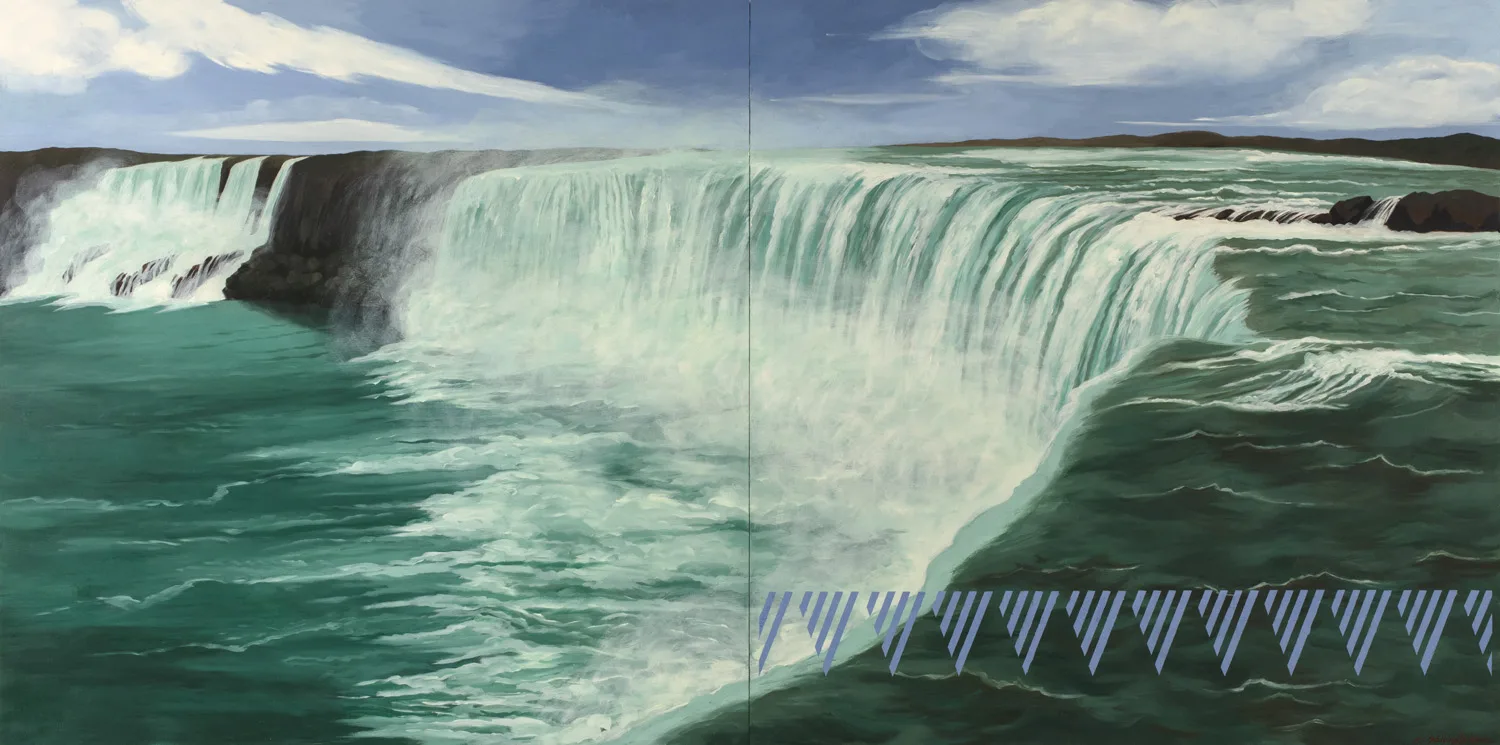
Highlights of the exhibition’s more than 30 works include WalkingStick’s paintings inspired by Hudson River School artists examples of her early painted sculptural abstractions inspired by nature; and several of her most recent paintings—like Niagara and Sagebrush Cholla—which overlay geographically specific abstract Indigenous patterns onto representational landscapes in order to re-assert an Indigenous presence long erased in European settlers’ depictions of North America as a pristine and unpopulated wilderness. Native American objects on loan from the artist and other museum collections, including woven baskets and a ceramic jar, offer insight into WalkingStick’s source patterns and artistic process.
Showcasing WalkingStick’s work alongside both Euro-American and Indigenous traditions of art, the exhibition demonstrates the complex ways the artist contends with and interweaves these artistic lineages. Niagara is grouped with two paintings of the iconic waterfalls by Louisa Davis Minot (1788-1858), which are among the few known works by her hand and rare examples of early 19th-century landscape paintings by a Euro-American woman. These works position WalkingStick within a lineage of women landscape painters in the Hudson River region while also considering the critical differences between the two artists’ approaches: Minot’s composition includes generic Indigenous figures to distinguish the site as North American, while WalkingStick uses a culturally specific Haudenosaunee pattern to mark the land as Indigenous.
Other works from The New York Historical’s collection demonstrate the Hudson River School artists’ attempts to forge landscape into an expression of national and cultural identity. These include Asher B. Durand’s Catskill Study, N.Y., ca. 1870, which invites direct communion with nature; Albert Bierstadt’s 1860 painting Indian Encampment, Shoshone Village, which promoted U.S. expansion westward; and John Frederick Kensett’s Pulpit Rock, Nahant, from 1859, depicting the touristic allure of coastal nature.
“In Kay’s paintings, landscapes are imbued with agency, through which contemporary Indigenous peoples and cultures exert their robust presence in history and modern society. Kay WalkingStick—long admired for her humanity, erudition, and grace—has been a trailblazing visual historian for 60 years,” said Dr. Agnes Hsu-Tang, board chair of The New York Historical.
Kay WalkingStick (b. 1935, Syracuse, NY) is a citizen of the Cherokee Nation of Oklahoma with Cherokee/Anglo heritage. Her six-decade career is both a visual record of her life experience and her attempt to present Native American history as a crucial part of America’s history. She draws on formal modernist painting traditions as well as the Native American experience to create works that connect the immediacy of the physical world with the spiritual. Attempting to connect the present with the past, her complex works hold tensions between representational and abstract imagery. Her paintings represent a knowledge of the Earth and its sacred quality. WalkingStick’s work is in many museum collections, including Denver Art Museum; Detroit Institute of Arts; Metropolitan Museum of Art; Minneapolis Institute of Art; Museum of Contemporary Art, San Diego; Museum of Modern Art (MoMA); Smithsonian American Art Museum (SAAM) and National Gallery of Art; National Gallery of Canada, Ottawa, Canada; Smithsonian’s National Museum of the American Indian; Philadelphia Museum of Art; Portland Art Museum; and Whitney Museum of American Art. She received a BFA from Beaver College (now Arcadia University), Glenside, PA in 1959 and an MFA from the Pratt Institute, Brooklyn, NY in 1975. She also has a PhD from both Arcadia University and Pratt Institute. She lives and works in Pennsylvania.
Accompanying the artwork are informative and engaging programs allowing visitors to dive deeper into the exhibition. Programs include:
MEMBER EXCLUSIVES
November 5 & 6 | Exhibition Preview – see the exhibition during regular museum hours before it opens to the public!
November 6 | Exhibition Opening Reception
ADULT PROGRAMS
Every Tuesday and Saturday at 11 a.m.| Exhibition Guided Tours
November 8 | Native American Heritage Month Celebration
November 14 | Acrylic Painting Workshop: The Landscape of Home
Key Takeaways:
- An Artistic Dialogue Across Eras: Kay WalkingStick / Hudson River School places contemporary Cherokee artist Kay WalkingStick’s landscape paintings in direct conversation with 19th-century Hudson River School masterworks, creating a rich visual interplay between Euro-American and Indigenous artistic traditions.
- Reclaiming Indian Territory: The exhibition explores how WalkingStick overlays geographically specific Indigenous patterns onto representational landscapes, reasserting a vibrant Native presence on lands historically depicted by European settlers as unpopulated wilderness.
- Deeply Personal & Historical Connections: Featuring over 40 works, the exhibition highlights WalkingStick’s direct responses to Hudson River School icons alongside her sole landscape referencing the Trail of Tears—a poignant nod to her Cherokee ancestors’ forced relocation.
- Rooted in Community & Conservation: By pairing fine art with traditional Native American basketry and ceramics that inform WalkingStick’s patterns, the exhibition serves as an educational hub, inviting visitors to reflect on environmental stewardship and the living history of the land we share.
####
About The James Museum of Western & Wildlife Art
The James Museum of Western & Wildlife Art provides experiences that inspire human connection and transformation through art depicting the peoples, landscapes, and history of the American West, and wildlife of the world. More than 400 premier works of art including sculpture, paintings and jewelry are on display in the museum’s 26,000 square feet of gallery space. The museum engages the community through programs and educational opportunities, for all ages, that bring our history to life and amplify voices that are not often at the forefront of mainstream Western art. When The James Museum opened in April 2018 it became one of the newest additions to St. Petersburg’s thriving arts community.
About The New York Historical Society
New York’s first museum, The New York Historical is a leading cultural institution covering over 400 years of American history. Our offerings span groundbreaking exhibitions; peerless collections of art, documents, and artifacts; acclaimed educational programs for teachers and students nationwide; and thought-provoking conversations among leading scholars, journalists, and thinkers about the past, present, and future of the American experiment. The New York Historical is a museum of museums and a collection of collections. We are home to the Patricia D. Klingenstein Library, the Center for Women’s History, the DiMenna Children’s History Museum, and the future American LGBTQ+ Museum. We elevate the perspectives and scholarship that define the United States’ democratic heritage and challenge us all to shape our ongoing history for the better. Connect with us at nyhistory.org or at @nyhistory on Facebook, Twitter, Instagram, TikTok, YouTube, and Tumblr.