Often with cultural objects and historic Native art in museum collections, we simply do not know who made something. Many records may note a cultural affiliation, if anything at all, in an object’s description. This lack of personal attribution can lead to objectification and distance a work from the person who created it and for whom it was made. In one remarkable case, from The James Museum’s collection, we have a rare instance of a set of objects where we know both the creator and the original recipient.
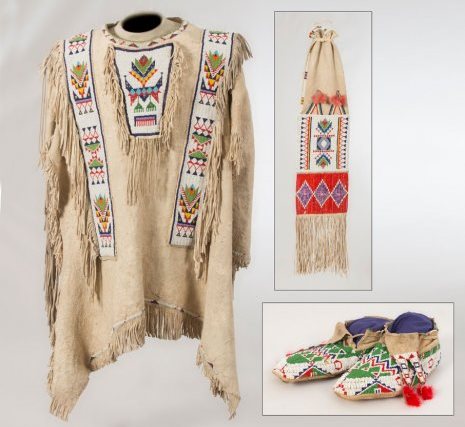
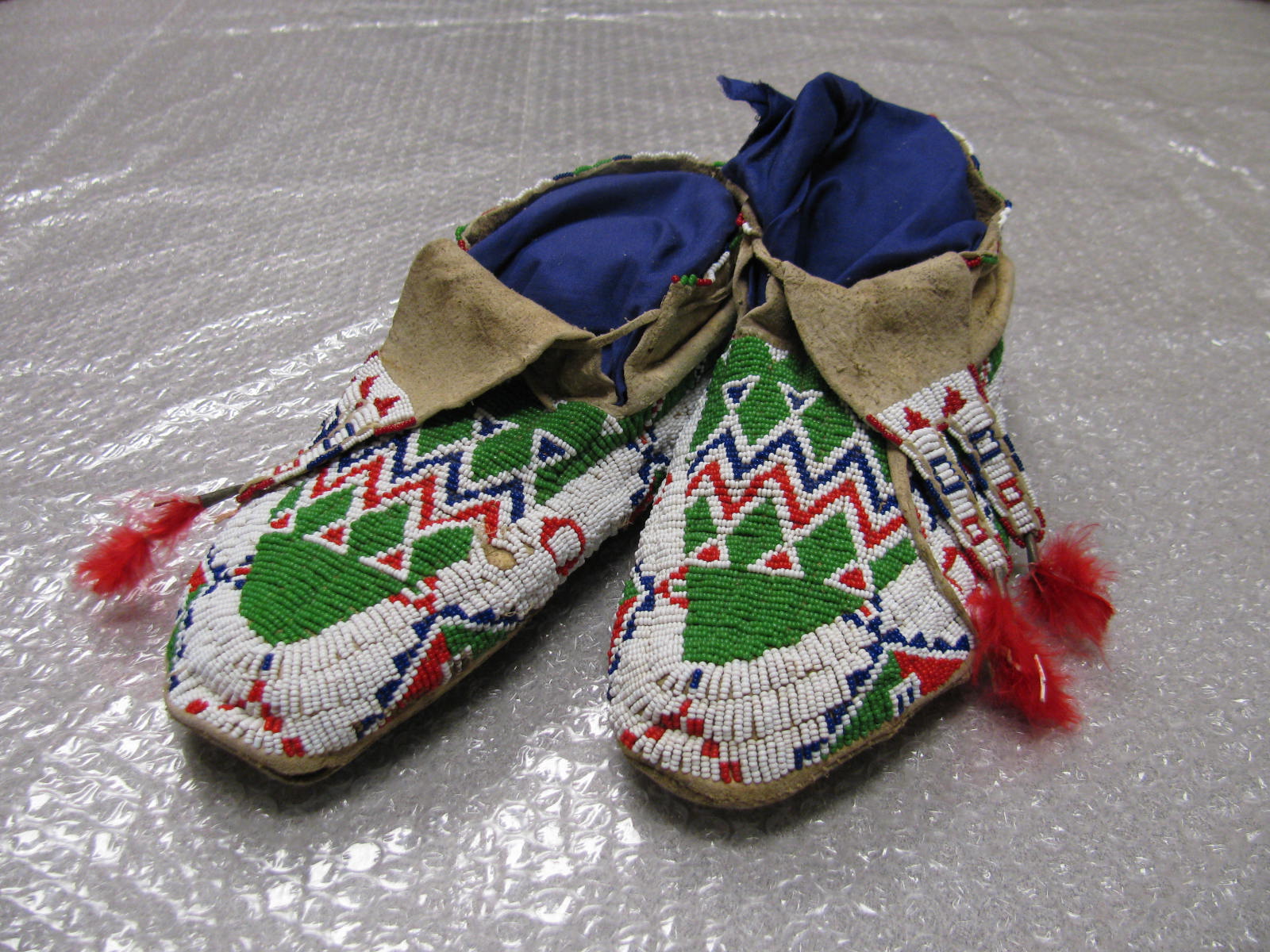
The set of beaded items (Figure 1.) includes a pair of moccasins, a buckskin shirt, and a beaded and quilled pipe bag. Our records show that these stunning items were made by Lakota artist Victoria Standing Bear-Conroy (1866–1964) for her son, Harry Conroy (1893–1974).[1]
The artist, Victoria, was born into a prominent Lakota family as the daughter of Matȟó Nážiŋ—later known as George Standing Bear—and Lena One Horse.[2] In 1882 when she was 16, she was sent away to attend the first Indian Boarding School—the Carlisle Industrial School.
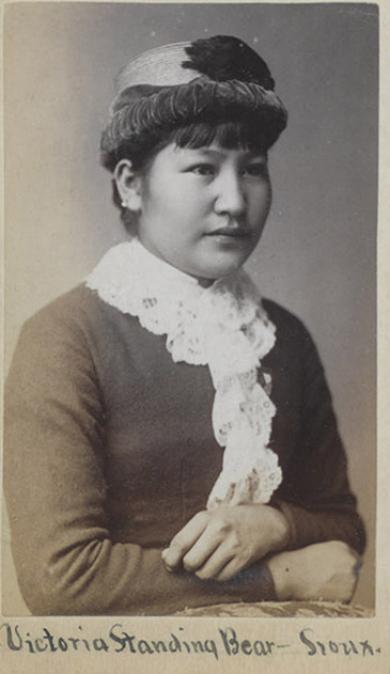
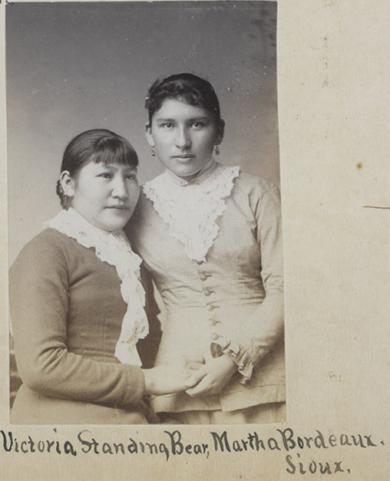
According to Carlisle records, Victoria spent five years learning laundry, housekeeping and sewing—the latter of which she became quite proficient in, as she was later the president of her local sewing society.[3] What Victoria’s school records do not note is that she also was trained by the matriarchs of her family in the art forms of beadwork and quillwork, which involve intricate embroidery of glass beads and dyed porcupine quills onto a surface—usually brain-tanned leather—using animal sinews as thread.
The beaded clothing that Victoria made demonstrates her sublime skill as both a bead and quillwork artist, as well as her innovation in terms of the complexity of her designs. While the reservation period was certainly one of indescribable challenges and changes, for Lakota artists it also resulted in a transformation in beadwork. Combating the threat of assimilation, Lakota women began to create more fully beaded, heavier clothes designed with the most complex work in their community’s history. A dress from this period can easily weigh 13–16 pounds from the sheer heaviness of the glass beads, and one fully beaded dress made by Victoria Standing Bear-Conroy for her niece is recorded as weighing 50 pounds![4]
[1] “Victoria Standing Bear Milk Conroy,” Findagrave.com, accessed 6 August 2025, https://www.findagrave.com/memorial/34484417/victoria-milk_conroy/.
[2] 1896 Indian Census, Pine Ridge Indian Reservation, M595_364, National Archives.
[3] “Victoria Standing Bear Student File | Carlisle Indian School Digital Resource Center,” accessed August 2025, https://carlisleindian.dickinson.edu/student_files/victoria-standing-bear-student-file.
[4] “Native American Clothing,” N.D. Aktá Lakota Museum & Cultural Center, accessed 15 August 2025, https://aktalakota.stjo.org/lakota-culture/beliefs-traditions/native-american-clothing/.